China’s $2 trillion megaprojects are breaking all records and changing the map of Asia forever
In 2025, China will complete some of the most ambitious and transformative infrastructure projects in human history—megaprojects worth over $2 trillion that will fundamentally alter Asia’s physical and geopolitical landscape. These projects are not just engineering marvels; they are strategic game-changers designed to shift trade routes, tighten control over sensitive regions, and strengthen China’s influence on the continent and beyond. With the completion of these massive undertakings, the entire map of Asia—and the global balance of power—will be redrawn.

At the heart of this construction boom is China’s 14th Five-Year Plan (2021–2025), a government roadmap that calls for massive investments in infrastructure, energy, and connectivity. Among its most significant projects is the Nyingchi Railway, a $44 billion marvel crisscrossing the Himalayas with tunnels and bridges, spanning unstable slopes at nearly 3,000 meters. This railway will reduce travel time between Tibet and the rest of China from days to just 13 hours, enabling the rapid transport of goods, tourists, and military supplies. However, it also runs dangerously close to disputed border areas with India, raising concerns in New Delhi about its potential dual use as a military corridor.
In addition to railway construction, China is currently completing the world’s highest bridge—the Huajiang Grand Canyon Bridge in Guizhou Province—which rises nearly 2,040 meters above a river gorge. This engineering feat symbolizes China’s determination to conquer its challenging terrain and connect remote regions. At the same time, the Tian Shangli Tunnel, which at 13 kilometers will become the world’s longest road tunnel, is nearing partial commissioning. Cutting through the Tian Shan Mountains, it will drastically reduce travel times and further integrate Xinjiang into China’s Silk Road Economic Belt, a cornerstone of the Belt and Road Initiative (BRI).

The BRI itself is a vast network of railways, ports, highways, and pipelines spanning Asia, Europe, Africa, and beyond. With potential investments totaling $8 trillion, it aims to open up new markets for Chinese goods, secure access to resources, and export China’s industrial capabilities. Key corridors such as the China-Pakistan Economic Corridor connect inland China to the Arabian Sea, while Chinese investments in ports from Sri Lanka to Greece extend Beijing’s logistical reach. This network not only promotes trade but also gives China strategic leverage over critical global supply chains, complicating Western efforts to form a united front against Beijing’s growing influence.
Energy infrastructure is another pillar of China’s megaprojects. The “Great Solar Wall,” a sprawling, nearly 400-kilometer-long solar corridor in the Inner Mongolia desert, is expected to produce 100 gigawatts of clean electricity by 2030—enough to power major cities like Beijing. This massive renewable energy project is in line with China’s goal of reducing emissions by 2030 and achieving carbon neutrality by 2060. It demonstrates how mega-infrastructure can also serve environmental ambitions.
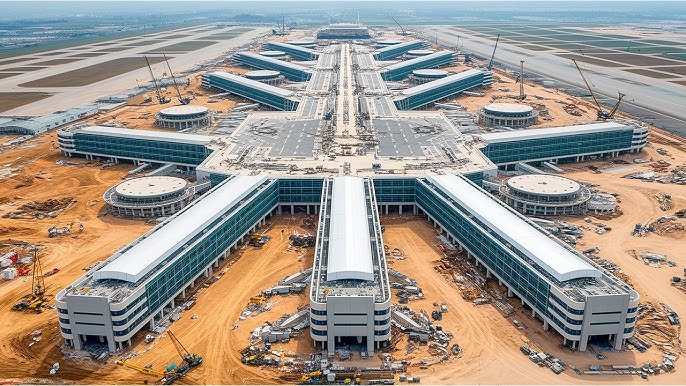
The scale of these projects is breathtaking: thousands of kilometers of high-speed rail lines, tunnels large enough for cargo ships, and power plants with outputs exceeding those of many small countries. They are transforming Asia’s economic geography, promoting regional integration, and creating new trade routes that bypass traditional bottlenecks. The knock-on effects include job creation, technological innovation, and the rise of supplier industries, strengthening China’s position as Asia’s economic powerhouse.
However, these megaprojects are not without controversy. Neighboring countries worry about China’s growing military and political influence, particularly where infrastructure overlaps with disputed territories. Critics also warn of “debt-trap diplomacy,” in which partner countries could become overly dependent on Chinese loans and political goodwill. Despite green initiatives, environmental concerns persist regarding the ecological impact of massive construction projects in fragile regions.

In summary, China’s $2 trillion megaprojects, which will be completed in 2025, are more than just infrastructure—they are strategic tools that are reshaping Asia’s map and global power dynamics. By connecting remote regions, securing trade routes, and expanding its influence, China, under his leadership, is ushering in a new era of Asian integration. Whether these projects herald prosperity or geopolitical tensions, their scale and ambition are undeniable, making 2025 a pivotal year for the future of the continent—and the world.