Footage Emerges of Kuwaiti Fighter Downing U.S. F-15E in Close-Range Incident
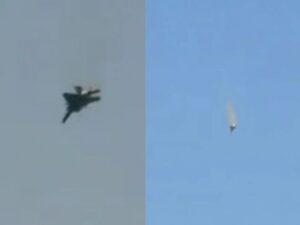
Newly released video shows a U.S. F-15E Strike Eagle being struck by a missile and exploding moments before a Kuwaiti F/A-18 Hornet is seen trailing at close range.
Footage circulated on social media on March 6 captures the moment a U.S. F-15E heavy fighter abruptly explodes and emits thick smoke. Shortly after, an F/A-18 Hornet appears, maneuvering nearby. The crippled F-15E, engulfed in flames, entered a freefall before its two-man crew successfully ejected.
Thomas Newdick, an editor at the military outlet The War Zone, noted the footage appears authentic, documenting a “Within Visual Range (WVR) engagement, likely involving an AIM-9 Sidewinder short-range air-to-air missile.”
“The U.S. fighter was hit from the rear by a low-yield missile. If the F/A-18 Hornet fired an infrared-guided missile like the AIM-9, the F-15E pilot would have had almost no warning until impact,” Newdick assessed.
A former U.S. Navy F/A-18 pilot remarked that the video underscores the bizarre nature of the incident. “There could have been a breakdown in engagement protocols or a catastrophic misidentification by both air traffic control and the pilot. However, such errors are nearly impossible under standard operating procedures,” he stated.
The former pilot explained that launching an AIM-9 typically requires switching to air-to-air combat mode, selecting the missile, and utilizing radar slaving. In this scenario, the radar locks onto the target while the fire-control system feeds parameters to the AIM-9, readying it for launch once the target is within range.
This process usually aids in Friend or Foe (IFF) identification, as the fire-control system queries the target. However, such active scanning can alert the opponent that they are being “locked,” prompting immediate defensive maneuvers. Alternatively, a pilot can use the AIM-9’s seeker head in “bore-sight” mode to lock onto a heat source directly, which bypasses the IFF query from the fire-control system. This is being eyed as a potential factor in the shoot-down.
“Even so, that doesn’t explain why a Kuwaiti pilot downed three F-15Es. One is a tragic mistake. Two is highly improbable. Three in a row is inexplicable,” the former pilot added.
While another former U.S. fighter pilot raised suspicions of an intentional, unauthorized engagement against an ally, Newdick dismissed the theory as unfounded.
“Distinguishing friend from foe in a theater as complex as the current Middle East is a significant challenge. The threat from Iranian aircraft remains persistent. Just this week, a Qatari F-15QA downed two Iranian Su-24s as they approached Al Udeid Air Base,” the expert noted.
The F-15E Strike Eagle, developed in the 1980s based on the two-seat F-15B, had a unit cost of approximately $31 million in 1998—roughly $62 million today, excluding ordnance.
On March 3, The Wall Street Journal cited sources familiar with the preliminary investigation, reporting that a Kuwaiti F/A-18 fired three air-to-air missiles, downing three U.S. F-15Es in a “friendly fire” incident the previous day.
U.S. Central Command (CENTCOM) declined to comment on the specific role of the Kuwaiti fighter. “It would be inappropriate to provide further comment while the incident remains under investigation,” the command stated.